

By the Royalsound factory team — children’s musical instrument manufacturer in Huai’an, China since 2003 · Updated October 2026
Buying a xylophone for a school is a different job from buying one for a home. The instrument has to hold its pitch after a year of daily lessons, appear in a procurement file with the right test reports attached, and fit an Orff-based lesson plan from the first week. This guide covers the decisions that actually matter — voice range, bar material, diatonic or chromatic, age grading, documentation — plus the specification sheet we ask school suppliers, distributors and brands to fill in before we quote.
1. Set the voice range first
An Orff classroom is built around a family of barred instruments, not a single model. Soprano carries the melody, alto fills the middle, bass holds the ensemble together. Three sopranos will cover individual practice; a working classroom group needs at least one soprano and one alto, and most school programmes eventually standardise on all three voices.
| Voice | Typical range | Bar size | Role in the classroom |
|---|---|---|---|
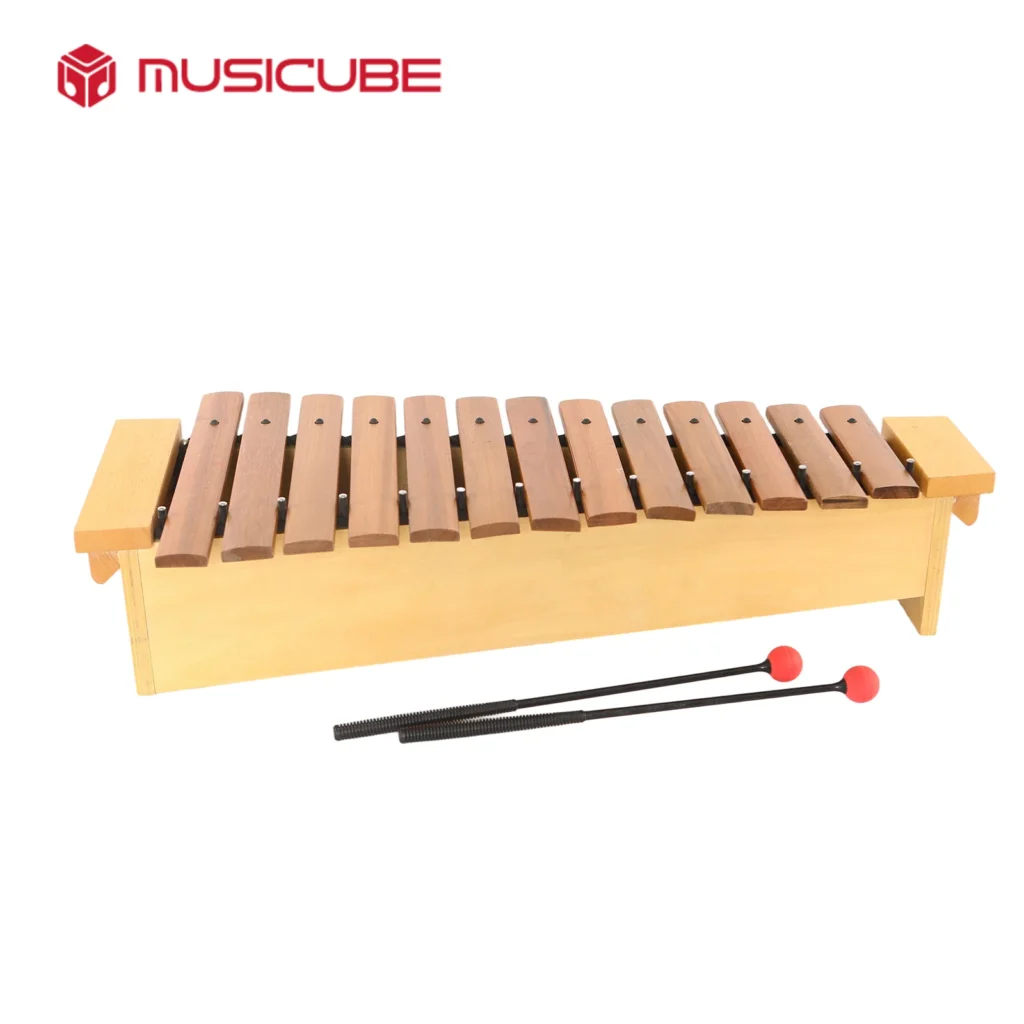
| Soprano xylophone | C5–A6 — 13 diatonic bars, supplied as a 16-bar set | 32 × 10 mm hardwood | Melody and ostinato lines |
| Alto xylophone | C4–A5 | 32 × 10 mm hardwood | Middle voice, harmony, partner melodies |
| Bass xylophone | Down to C3 | 36 × 12 mm hardwood | Foundation line, ensemble anchoring |
Two practical notes. The bass instrument is the one schools most often skip in the first order and buy a year later — if the programme runs ensemble work, budget for it from the start. And larger instruments take heavier mallets and produce more volume, so a mixed set needs matched mallets rather than one type for everything. Our full xylophone and glockenspiel range lists sizes and carton data for each voice.
2. Xylophone, glockenspiel, metallophone, chime bars: what actually changes
These four get marketed together and confused constantly. The difference a teacher hears is how long a note sustains; the difference you pay for is the bar material.
| Instrument | Bars | Typical range | Where it fits |
|---|---|---|---|
| Xylophone | Hardwood, rosewood tone — 32 × 10 mm (soprano/alto), 36 × 12 mm (bass) | C3 to A6 across the three voices | Main melodic work; short, dry attack |
| Metallophone | Aluminium, 32 × 8 mm | C5–A6 soprano; C4–A5 alto | Long sustain; the easiest voice for a young ensemble to hear |
| Glockenspiel | Special steel, 20 × 2 mm or 22 × 2 mm | C6–C7 on 8-note models | High sparkle, doubling the melody an octave up |
| Resonator bars / chime bars | Anodised aluminium, 25 × 3 mm | C5–C6 on 8-bar sets | One bar per child; whole-class group playing |
Metallophones are often the purchase that changes a classroom most: the sustain lets a group hear whether it is playing together, which is why many programmes add them before buying more xylophones. Resonator bars and hand chimes solve a different problem — when each child holds one bar, a whole class can play a melody without a full instrument per child.
3. The parts that decide how it looks in year three
Bar material and finish
Hardwood bars with a rosewood tone give the warm, fundamental-heavy sound most Orff repertoire expects. Beechwood bars at 25 × 10 mm are the standard choice for smaller 8-note classroom models. Coloured bars are painted or laminated; natural bars carry a clear finish. Ask which one, and ask whether the finish is water-based — a classroom instrument gets wiped down weekly and occasionally chewed.
The resonator box
The box does two jobs: it amplifies, and it holds the frame square so the bars stay properly supported. On our hardwood line the resonator box is built from solid and 12 mm laminated birch, FSC certified; other models use beechwood, pinewood or basswood plywood. All-wood construction with pinned bars is the pattern that survives the most school environments.
Fittings, storage and mallets
Two details get left out of tender documents and then cause complaints. First, how the bars are held — pins versus cord — because that determines how easy the instrument is to service in a school workshop. Second, whether the instrument stores its own mallets; integrated storage sounds trivial until you see a classroom after a term. Put the mallet type and quantity in writing: wooden ball mallets are standard for the barred instruments above, and a mixed set should ship with mallets sized to each voice.
4. Diatonic or chromatic?
A 13-bar diatonic instrument is a full working instrument, not a beginner’s compromise. The reason our 13-bar soprano, alto and bass xylophones ship as 16-bar sets is that the extra bars — two F-sharps and one B-flat — are what let the instrument play in G major and F major. Without them, any piece outside C major simply stops. That is the first thing to check on a quotation: it should state the total number of bars, not just “13 diatonic”.
Chromatic instruments come later, and they come in three shapes worth knowing:
- 23-bar chromatic alto glockenspiel — chromatic from C5 to A#6.
- 25-bar chromatic glockenspiel — two octaves, G5 to G7, in a briefcase-style case with a carry handle.
- 27-bar chromatic glockenspiel — piano-key layout in black and white, useful where a teacher wants keyboard orientation built into the instrument.
Equipping a classroom from nothing? Buy diatonic first. It covers the majority of school repertoire and costs less per voice. Add chromatic instruments when the programme moves into literature that modulates.
5. Tuning: what to check before you approve a sample
What “fundamental tuning” and “tuneable to C, G, F” mean
Fundamental tuning means the bar’s primary pitch is tuned and the higher partials are left as they fall. On our diatonic xylophones and metallophones the instruments are set up for use in C major, G major or F major — which is exactly why the F-sharp and B-flat bars ship with them. On the hardwood line, bars are printed with note names and staff positions, so a teacher can see what to play rather than counting bars.
Five checks on a pre-production sample
- Play every bar with the mallet the instrument actually ships with, at classroom volume — not tapped lightly at a desk.
- Check each note against an external tuner across the whole range, not just the middle octave.
- Confirm the bar count and range on the sample match the specification sheet and the quotation.
- Look at how the bars sit: uniform support, no rocking, no contact with the frame where there should be none.
- Wipe the finish once with a damp cloth. If the colour moves, the finish is not what was quoted.
Approving a sample is what protects the bulk order. Settling the specification at sample stage is far cheaper than arguing about tolerance after the container has sailed.
6. Age grading and the paperwork behind it
Our barred instrument lines are graded at 3+, 4+ and 6+, and the grading tracks how the instrument is played rather than its size:
- Age 3+ — 8-note glockenspiels and xylophones with two mallets; a single octave, simple to hold.
- Age 4+ — 8-bar resonator bars, hand chimes, chromatic glockenspiels in a case, and the alto glockenspiel.
- Age 6+ — the 13-bar diatonic xylophones and metallophones, where diatonic ensemble work begins.
For a school order, documentation is usually what holds up the purchase order, so settle it early. Ask for third-party test reports matched to the exact model you are buying, and for the report number rather than a scanned logo: EN 71-1, -2 and -3 plus REACH for the EU; ASTM F963 and CPSIA — including lead and phthalates — for the United States. Where solid timber is specified, FSC documentation should come with the material. Where a product is not suitable below a given age, that has to be printed on the product and in the instruction sheet, not merely agreed by email.
Tell us the model and destination market and we will send the documents that cover that model, so your buyer can file them with the quotation.
7. What to put in your RFQ
The fastest way to get comparable prices from several suppliers is to ask all of them the same way. This is the specification sheet we work from:
| Field | What to state |
|---|---|
| Voice and type | Soprano / alto / bass; xylophone, metallophone, glockenspiel or resonator bars |
| Bar count and range | 8, 11, 13 diatonic (16-bar set), 23, 25 or 27 chromatic; target pitch range |
| Bar material | Hardwood, beechwood, steel, aluminium — with bar dimensions if you have a reference sample |
| Resonator | Solid wood, laminated, plywood, or a cased model |
| Finish and markings | Coloured or natural; note names, staff positions, your logo |
| Age grade | 3+, 4+ or 6+ as required in your market |
| Accessories | Mallet type and quantity, mallet storage, cloth bag or case |
| Compliance | Destination market and the reports your buyer has to file |
| Packaging | Retail-ready or bulk; individual boxes, carton dimensions, sets |
| Quantity and schedule | First order, target annual volume, delivery window |
| Terms | Incoterms, port, and any labelling or marking requirement |
8. Customisation, if you are buying under your own brand
Most of the changes our OEM customers ask for on barred instruments sit in four places: the bars (coloured or natural, printed note names), the frame and resonator finish, the branding (logo on the instrument and on the box), and the packaging. Beyond that, sets can be assembled to a curriculum — mixing xylophones, glockenspiels and small percussion into one retail-ready kit under your own label. The scope of any project depends on the model, the order quantity and the specification agreed at sample stage; our OEM manufacturing and packaging and kitting pages set out how that runs in practice.
9. Five questions that separate a factory from a listing
- Reports, not logos. Ask for the report number and the model it covers.
- A sample before bulk. Any supplier who will not send a pre-production sample for evaluation is a risk on a school order.
- Written QC gates. Incoming material check, in-line checks, and a pre-shipment inspection against your approved sample, with photos before packing.
- Terms in writing. MOQ, unit price by quantity tier, lead time and its starting point, Incoterms and port. On standard models our MOQ starts at 200 pcs and some lines at 500 pcs; samples take 7-15 days and bulk production 25–45 days after deposit receipt, FOB Qingdao, Shanghai or Ningbo.
- Someone who answers specifically. If the reply to “how is this graded for age 6+” is a generic certificate, the rest of the project will run the same way.
Quick answers
What is the difference between a xylophone and a glockenspiel?
How many xylophones does a classroom need?
What age are xylophones suitable for?
Should I buy diatonic or chromatic instruments first?
What certifications do schools ask for on barred instruments?
What is the MOQ and lead time on xylophones?
Related reading
- How to choose the right classroom percussion set for schools
- CE and ASTM F963 updates: what OEM buyers need to know for 2026
- Supplying instruments for music education and schools
Barred instruments in this range
 Soprano Xylophone – 13 Diatonic Bars16-bar set · C5–A6 · SKU 051305
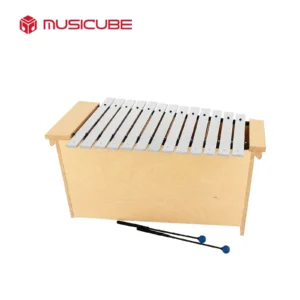 Bass Xylophone – 13 Diatonic Bars16-bar set · down to C3 · SKU 051307
Specify your classroom set
Send the voice range, bar count and destination market, and we reply within 24 hours with pricing, MOQ, lead time and the test documentation for the model.