


By the Royalsound team — every classroom percussion set here is built in our own plant in Huai’an, Jiangsu, and supplied to schools and distributors since 2003 · Updated October 2026
A classroom percussion set for thirty children is not a bag of small instruments. It is a four-family kit — skin, wood, metal and shaken — where each family carries a different job in the lesson, and where the pieces that fail first are almost always the same three. Below: what belongs in the set, how age grading changes it, what to check on a sample, and what to write into the specification so the set is still complete in year three.
What a classroom percussion set has to do
The unpitched half of an Orff room exists because thirty children cannot all hold a xylophone. Roughly ten are on barred instruments at any moment; the other twenty need something that holds a beat, marks a phrase or makes a sound effect without needing pitch. A classroom percussion set is the equipment for those twenty.
That rules out two common purchases: the decorative assortment that looks complete in a catalogue photo but gives twenty children four playable instruments and a lot of shakers, and the single-family bulk buy where a school orders forty tambourines because tambourines were on offer.
The Orff-Schulwerk literature makes the point that the small instruments are not filler. The Alliance for Music Merchants’ description of the approach says unpitched hand percussion covers the small instruments of a music classroom, that “each must be of a quality that will produce an interesting and satisfying sound,” and lists them as maracas, claves, tone block, triangle, jingles, finger cymbals, suspended cymbal, tambourine, cowbell and various sizes of hand drum.1 Quality, in that sentence, is a specification requirement, not a marketing adjective.
The four families and the job each one does
Classroom percussion is conventionally grouped into four families. The grouping matters because a set that is missing a family cannot play a full arrangement, no matter how many pieces it contains.
Skin, or membrane. Hand drums, bongos, frame drums, tambourines with heads. These carry the pulse and the low end. A room with no skin instruments has rhythm but no floor to it.
Wood. Claves, wood blocks, rhythm sticks, guiros, castanets. Short, dry, articulate sounds. This is the family that makes a fast subdivision audible — the difference between a class playing quavers and a class playing mush.
Metal. Triangles, finger cymbals, jingles, suspended cymbals, cowbells. Long sustain and high frequency, so they cut through thirty children. Used sparingly they mark section changes; used freely they mask everything else.
Shaken. Maracas, egg shakers, cabasas, rain sticks. Continuous sound rather than attack. The easiest family for a young child to play in time, and the one that fills the background layer.
A practical set allocates by family first and by piece count second. Twelve pieces spread across four families will outplay twenty pieces drawn from two.
The eight pieces that break first
After a few years of daily use, failures cluster. They are worth knowing because each one is a specification decision you can make in advance.
Drum heads. A hand drum fails at the head, not the shell — usually a split at the bearing edge after the instrument has been dropped or stacked. Fixed heads cannot be replaced, which converts a repairable drum into scrap. If the budget reaches tunable heads on the two or three largest drums, it is better spent there than on extra shakers.
Tambourine jingles. The jingles are held by pins through a slot in the frame. Repeated impact widens the slot, the jingle rattles off-centre, and the instrument starts to buzz instead of ring. A double-row tambourine with a wooden frame lasts longer than a single-row plastic one, and the failure is visible on inspection before it is audible.
Wood block and clave edges. Striking the same spot thousands of times compresses the grain and then splits it. End-grain contact surfaces and a chamfered edge survive noticeably longer than a sharp square edge.
Triangle beaters and clips. The triangle itself rarely breaks; the beater and the holding clip do. Both are consumables and should be ordered as spares rather than as replacements.
Guiro scrapers. The scraper wears smooth before the body does. On a guiro with a wooden scraper, the scraper is the part to stock.
Shaker fill. Sealed shakers are fine until a seam opens and the fill escapes. A stitched or screwed closure is worth the difference in price in a room with thirty children.
Castanet hinges. The cord or hinge goes before the wood. Handle-mounted castanets on a single stem avoid the problem entirely.
Storage trolley castors and joints. The trolley is used more often than any instrument in the set and is almost never specified. Castors fail on stairs and thresholds, and a trolley with a dead castor gets abandoned in a corner.
None of these is a manufacturing defect. They are the natural end of a wear cycle, and the difference between a set that lasts five years and one that lasts two is whether the specification anticipated them.
Age grading changes the set more than the budget does
The same thirty children need a different set at five and at eleven, and the change is not mainly about quantity.
At three to five, the constraint is grip and mouthing. Instruments have to be large enough to hold with a whole hand, light enough to lift, and free of small detachable parts. Shakers, rhythm sticks and a frame drum do the work; triangles and jingles are usually withheld because the holding loop invites swinging.
At five to seven, the constraint shifts to independent playing. One instrument per child, no sharing mid-activity, and a set that can be distributed and collected in under two minutes. This is where a class set of identical shakers and sticks earns its place — not because variety is bad, but because thirty different instruments cannot be handed out quickly.
At seven to eleven, the constraint becomes ensemble balance: children can hold a part, so the set needs contrasting timbres playing at once. This is the age band where a thin four-family set stops working.
Buying one set to serve all three bands is a compromise that usually fails the oldest group. Where a school covers the full range, two sets — one for the early years and one for the upper primary room — will be played more than one large set split between them.
How many of each for a class of thirty
The working assumption for a class of thirty is ten on barred instruments and twenty on unpitched percussion, with rotation. That gives a workable split for a set of roughly forty percussion pieces:
| Family | Pieces for 30 children | What it buys |
|---|---|---|
| Skin | 6–8, including two larger drums | Pulse, low end, and a part the whole room can feel |
| Wood | 8–10, in pairs | Fast articulation and rhythmic question-and-answer |
| Metal | 6–8, mostly triangles and jingles | Accents, section markers, sustain |
| Shaken | 10–12, in matching sets | Continuous background layer, easy entry for the youngest |
| Beaters and spares | Two per struck instrument, plus a spare bin | Keeps the set playable between orders |
If you are sizing a whole programme rather than one room — several classrooms, a shared hall, a phased budget — the arithmetic is in our guide to how many instruments a classroom needs. This page stays with the contents of one set.
What to check on a sample before you approve it
A percussion sample is checked by hand, in five minutes, and the five minutes decide the next three years.
Sound, one at a time. Strike each instrument alone in a quiet room. A wood block that thuds rather than rings, or a triangle that has no bloom, will not improve in a full classroom.
Sound, all at once. Then strike everything together. If the metal disappears under the skin and wood, the balance is wrong and no amount of tuning will fix it.
Edges and joins. Run a thumb along the playing edge of every wood instrument, and around every drum bearing edge. A sharp edge or a visible gap is a failure that will show up as a split later.
Fixings. Turn every jingle, shake every shaker, and open and close every castanet. Loose fixings are the most common defect on a first production run and the cheapest to catch.
Weight in a child’s hand. Hand the sample to a five-year-old if you can. A drum that an adult finds light can be too heavy to hold for a whole activity.
Care and cleaning. Ask what the surfaces are finished with and whether they tolerate a standard school disinfectant wipe. An instrument that cannot be cleaned will be cleaned anyway.
Storage decides whether the set survives
Most percussion damage happens between lessons, not during them: bars and sticks stacked in a cupboard, drums piled, jingles crushed against a shelf. Storage is part of the set, not an accessory.
Three arrangements work: a lidded box with compartments for a set that moves between rooms; a wall-hanging organiser for a room with no floor space, which also keeps instruments visible and therefore used; and a wheeled cart for a room that keeps the whole set out and playable.
What does not work is a deep cupboard with no compartments. It is also what most schools already have, which is why the first purchase after a set is so often a trolley or a box — and why specifying storage with the set is cheaper than buying it two years later.
What to write into the specification
A percussion specification fails when it lists names and quantities only. The rest is what decides whether the delivered set matches the sample.
Family allocation, not just a total. “Forty pieces” is not a specification. State how many in each of the four families, and name the largest drum.
Age grade per item. A set that includes a small-parts instrument for a three-year-old room will be rejected on inspection, correctly.
Materials at the level you can check. Wood species or at least hardwood versus softwood; head type on the drums; plated versus solid metal on the jingles. If the specification does not name it, the quotation will choose it for you.
Spares as a line item. Two beaters per struck instrument, plus a small bin of the pieces that fail first — triangle clips, guiro scrapers, castanet cords.
Storage in the same shipment. Box, trolley or wall organiser, delivered with the set rather than quoted separately.
Certification by destination. EN71 for the EU, CPSIA and ASTM F963 for the US, GB 6675 for China. Ask for the report list by item, because a percussion set spans four families and one report will not cover them.
If you hold a quotation from another supplier, send it: we price against the same list and mark where we differ.
Repair or replace: the parts decision
A percussion set rarely fails all at once. It thins: two triangles lose their clips, a drum head splits, the guiro scraper goes smooth. Schools then either replace the whole set — expensive and unnecessary — or let it degrade until the room cannot play a four-part arrangement.
The cheap fix is to treat consumables as consumables. Beaters, clips, scrapers, cords and shaker closures should be orderable by the dozen, matched to the instruments already in the room. Fixed-head drums are the exception: once the head goes, the drum goes, which is the argument for tunable heads on the two or three drums that take the most use.
Ask for the compatible spare list by item number when you order. It costs nothing at quotation stage and decides whether the set is still complete in year three.
How to start
Send the age band, the class size and the destination market. We will come back with a family-by-family set list, the spare list and the certification set for your market, usually within 24 hours.
If you want to see the instruments first, ask for a sample plan — samples are built on the production line that will run the order, so the finish and the balance you approve are the ones you receive. The full range sits in our Orff instrument sets section; for the manufacturing side of a percussion range — shell specs, head types, carton maths — the percussion range guide goes deeper, and the xylophone selection guide covers the barred half of the same room.
Quick Answers
What should a classroom percussion set contain?
How many percussion instruments does a class of thirty need?
What breaks first in a school percussion set?
Should I buy fixed-head or tunable hand drums?
How do I check a percussion sample before approving it?
Explore Our Instruments
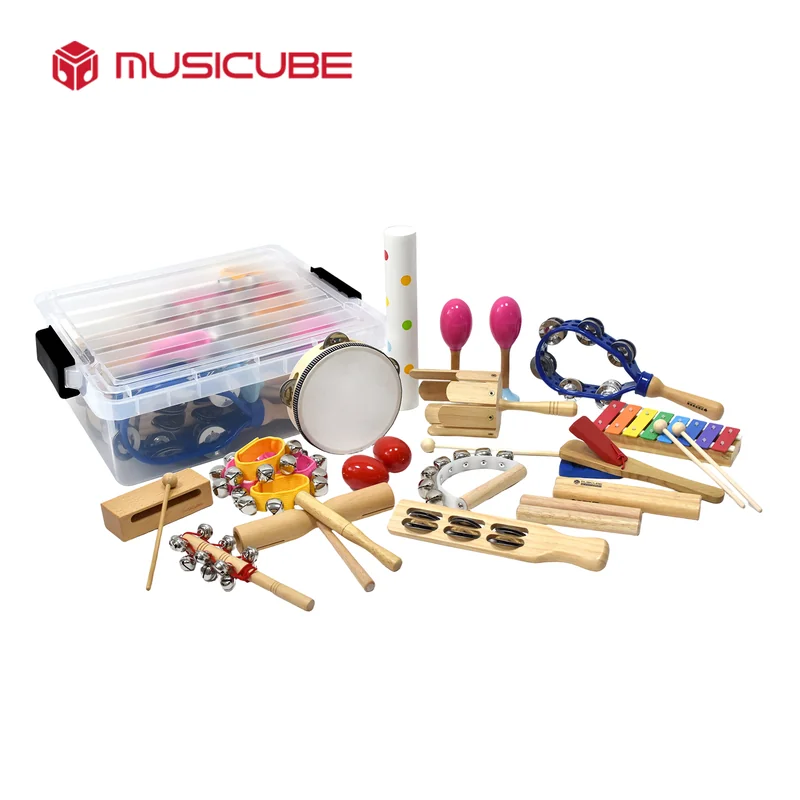 Classroom Percussion Set – Storage BoxFour families · 200401
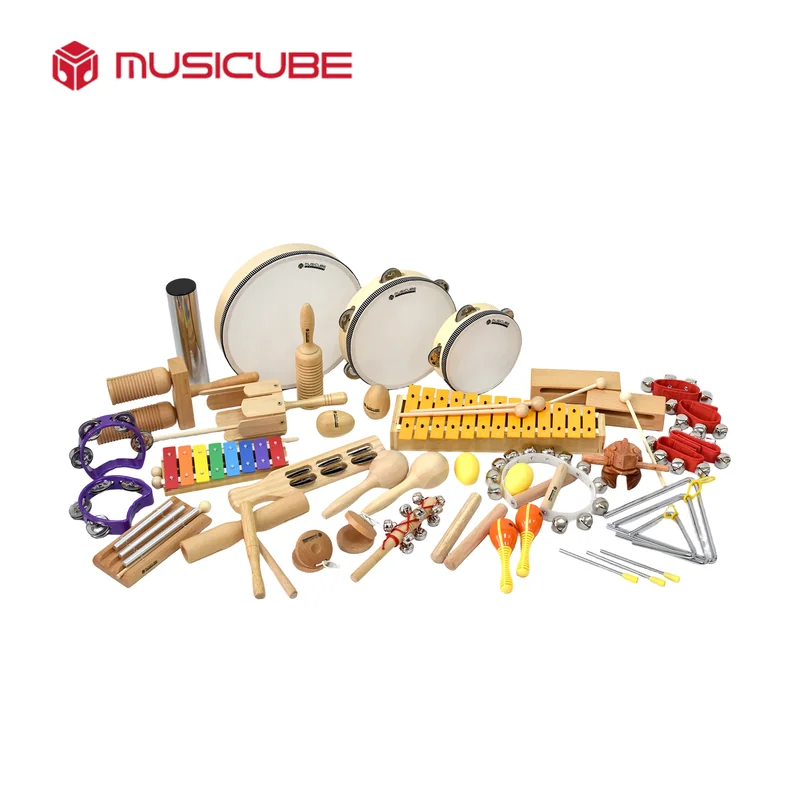 Large Percussion Set – Drums & XylophoneDrums plus barred · 200402
 Wall-Hanging Percussion SetCanvas organiser · 200403
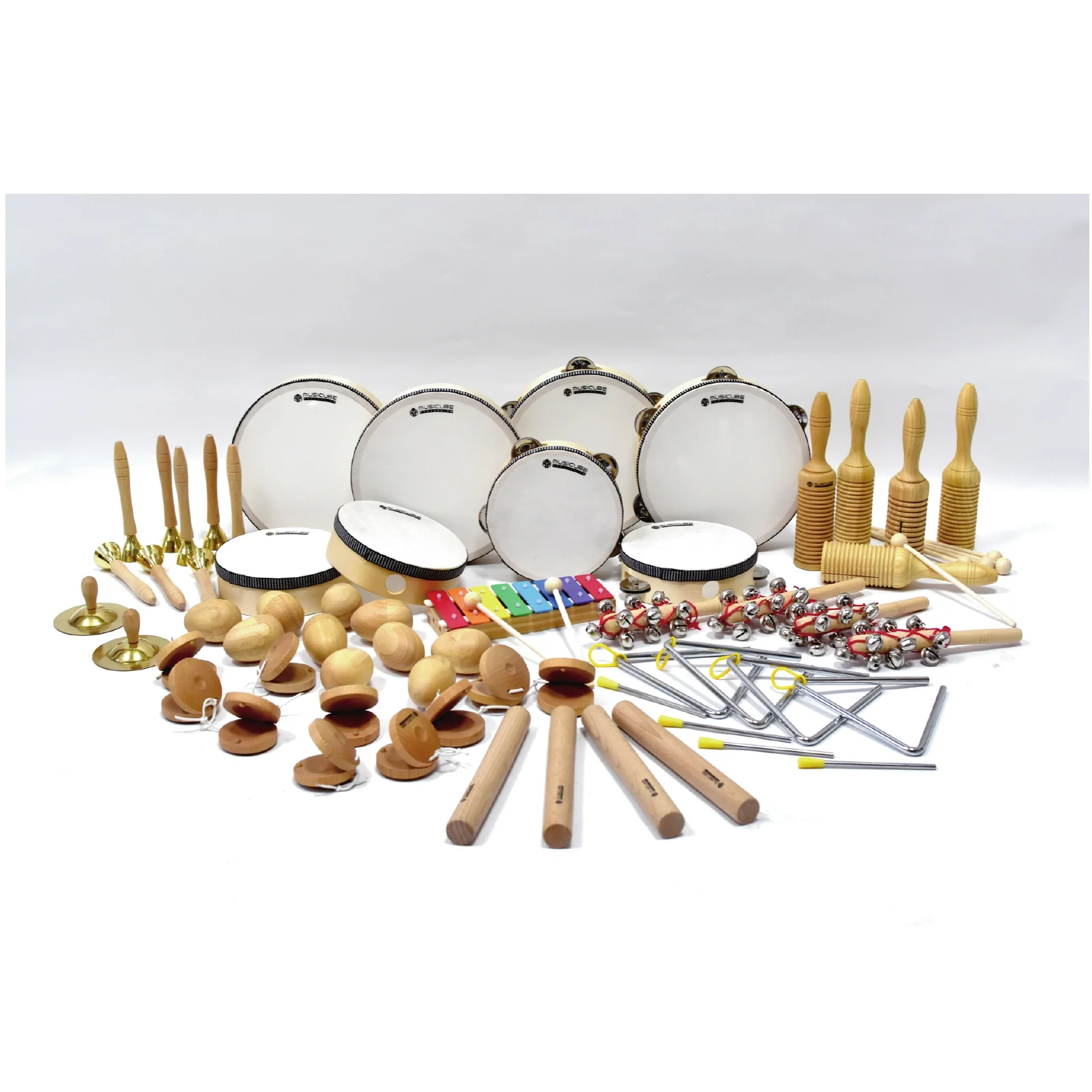 Percussion Set – Storage Cart39 pieces · 204067
Request a Quotation
Send the age band, class size and destination market. We reply with a family-by-family set list, the compatible spare list and lead time within 24 hours.
1. Alliance for Music Merchants (AAMM), “The Orff-Schulwerk Approach” — resource page describing unpitched hand percussion and the Orff instrumentarium. Retrieved 31 October 2026; the passage cited is in the “Playing Instruments” section.