


Orff instrument storage, sized from the boxes rather than the brochure: what our own resonator boxes measure, why a barred instrument cannot be stacked, and the thirty-six add-on bars a twelve-piece set starts losing in its first term · Updated November 2026
A music room is rarely short of storage. It is short of a measurement. Every catalogue sells the container and almost none publishes the thing being contained, so the shelving gets built, the instruments arrive, and the bass turns out to be deeper than the shelf. This page supplies the missing half: the box dimensions, the arithmetic that turns them into a shelf run and a floor area, and the component that goes missing first.
Orff instrument storage is a dimension problem
Ask a supplier what a room needs and the answer comes back as a container type: an instrument cart, a table stand, a xylophone stand, a lockable cabinet. That is a real taxonomy, useful for choosing between four things, but not a specification: none of those categories carries a number. The largest retailer in this market describes what each container is for and never says how deep its shelves are, how many instruments fit, or what clear height it leaves above a bass bar. Soft storage is the same: sold by instrument and by brand rather than by measurement.
The gap has a cause. A retailer sells a container asked to hold instruments from more than one maker, so any capacity figure it published would be wrong for most customers. Only the manufacturer can publish the other half, because the manufacturer controls the box. So start from the wrong end: the room is planned from the boxes, and the furniture bought to clear them.
The three numbers, and the one that is always wrong
Three measurements decide whether an arrangement works: shelf depth, clear height above it, and the linear run available. Two are usually got right. Depth is almost always got wrong, because product listings lead with length.
A soprano xylophone is 615 mm long, and 615 mm is the number a buyer remembers. Its resonator box is 187 mm deep and 131 mm high. The bass in the same family is 674 mm long but 267 mm deep and 356 mm high. Specify the shelf from the length and the depth never gets checked, so a 250 mm shelf that looks generous against a soprano will not take a bass at all, and will take an alto at 226 mm with 24 mm to spare — enough to hold the instrument, not enough to stop the box overhanging the lip when a child pulls it out.
Height fails in the opposite direction. A shelf spaced to clear a soprano at 131 mm wastes 225 mm over a bass at 356 mm; spaced for the bass everywhere, two usable tiers collapse into one. The numbers have to be read as a set.
Three details cost nothing to specify once the numbers are fixed. Put the bass on a plinth rather than at floor level, playing surface between 400 and 500 mm, so a seated child reaches the bars and the resonator stays off a floor that gets mopped. Give every shelf a 20 mm raised front edge, without which the bar that falls is usually a bass bar. And check door thresholds before choosing a wheeled cart: a dead castor turns a mobile set into a fixed one, and it fails at the joint rather than the wheel.
What our boxes measure, instrument by instrument
Every orff instrument storage decision below comes from these published resonator box dimensions, read from our own specifications on 2 November 2026. Box only: no legs, stand or clearance allowance. Footprint is length times width.
| Instrument | Item | Resonator box, mm | Footprint | Clear height |
|---|---|---|---|---|
| Soprano xylophone | 051305 | 615 × 187 × 131 | 0.115 m² | 131 mm |
| Alto xylophone | 051306 | 645 × 226 × 221 | 0.146 m² | 221 mm |
| Bass xylophone | 051307 | 674 × 267 × 356 | 0.180 m² | 356 mm |
| Soprano metallophone | 051301 | 615 × 187 × 131 | 0.115 m² | 131 mm |
| Chromatic glockenspiel, 27 bars | 052701 | 452 × 260 × 43 | 0.118 m² | 43 mm |
Two entries matter more than the rest. The soprano metallophone and the soprano xylophone share a box to the millimetre, which is the only reason a pair can be stacked at all. And the glockenspiel is not a box: it is a 43 mm briefcase with a handle and foldable legs, stored on a different rule entirely.
The bass is not a scaled soprano: its specification lists six bars at 36 × 10 mm because a bass needs mass where the fundamental is. That is why its box is 356 mm tall, and why the bass decides the shelf rather than fitting on it.
A barred instrument cannot be stacked
The intuitive move in a full room is to put one instrument on another. It detunes a set quietly. A bar sits on two pins above a hollow resonator and rings because nothing touches it except those two points. Load the top of an instrument and the load arrives through the bars, which either lifts them off their pins or presses them onto the resonator rim. The instrument still looks right, still plays, and no longer has the sustain it was bought for. A teacher notices a dead bar months later and blames the mallet.
The box makes it worse. The top of a resonator box is a frame around an open cavity, not a deck: it is built to be carried by two hands at the ends. And with boxes at 131, 221 and 356 mm, anything stacked sits at an angle, so the weight lands on one edge instead of spreading.
Exactly one stacking is safe, and the dimensions hand it to you: identical boxes. A soprano xylophone on a soprano metallophone sits flat because the frames match in size and height. Nothing else in the range does. If the room needs vertical capacity, the answer is a second shelf tier, not a second layer. Dust belongs here too: an open resonator is a dust trap, and dust on a bar is a damping problem before it is a cleaning problem. A cover is cheaper than a shelf, but no cover survives being used as one.
The accidentals are the first thing a room loses
Every barred instrument we make has a 13-bar diatonic core plus the three bars that turn C major into G or F: two F-sharps and one B-flat. Each ships with a cloth bag for those three, because there is nowhere on the instrument to keep them.
That is the most under-specified part of an Orff room, and it is arithmetic rather than opinion. A twelve-piece barred core holds thirty-six add-on bars, twenty-four F-sharps and twelve B-flats, none with a home. They are not lost while being played but in the ninety seconds between being taken off and put back, four or five times a day, thirty-eight weeks a year. No school loses them all at once; it loses the same three or four repeatedly, until a term arrives where the F-sharp is gone and the class plays in C.
Two arrangements fix it, both cheap if specified with the instruments rather than bought later. A labelled pocket at the end of each box, so the bars travel with the instrument they belong to. Or one shallow tray per room, divided into thirteen labelled compartments with a count sheet taped inside the lid, so a missing bar shows at the end of a lesson rather than turning up in September.
Neither replaces a bar that has already gone. That is a parts order with its own rules: which component of a barred instrument is replaceable, and what a spare-part order has to say.
A twelve-piece barred core needs 7.3 metres of shelf
Take an ordinary barred core: four soprano xylophones, four alto xylophones, two bass xylophones and two chromatic glockenspiels. The mix is an illustration, not a provision ratio — that is answered in how many instruments a programme actually needs. What matters here is what twelve boxes add up to.
In a single row the lengths are 4 × 615 mm, 4 × 645 mm, 2 × 674 mm and 2 × 452 mm. That is 2,460 + 2,580 + 1,348 + 904, or 7,292 mm of shelf edge, on a shelf at least 267 mm deep because the bass sets the depth. Run times depth gives a shelving unit occupying 1.95 m² of floor before a child stands in front of it.
Two conclusions follow, both unwelcome in a real building. A 4.5 metre wall will not take this set in one row, so either the run goes to two tiers — same wall, same 2 m², twice the shelf edge — or the set is cut to fit. And the 1.95 m² is furniture, not room: a bass needs a player seated at it, so roughly a metre of clear floor runs along the front, and that is the figure a business manager has to find.
Where the floor actually goes
The unpitched half of the room is a different problem: there the container is bought rather than inherited. Our five formats say what no category page does — whether a container stands up or lies flat changes the floor you spend by a factor of fourteen.
| Item | Format | Pieces | Published size | Footprint | Per piece |
|---|---|---|---|---|---|
| 204067 | Storage cart, upright | 39 | 500 × 250 × 770 mm | 0.125 m² | 0.003 m² |
| 204062 | Storage tote | 31 | 475 × 350 × 270 mm | 0.166 m² | 0.005 m² |
| 204061 | Storage tote | 17 | 395 × 280 × 235 mm | 0.111 m² | 0.007 m² |
| 200213 | Storage bag, flat | 8 | 460 × 805 mm | 0.370 m² | 0.046 m² |
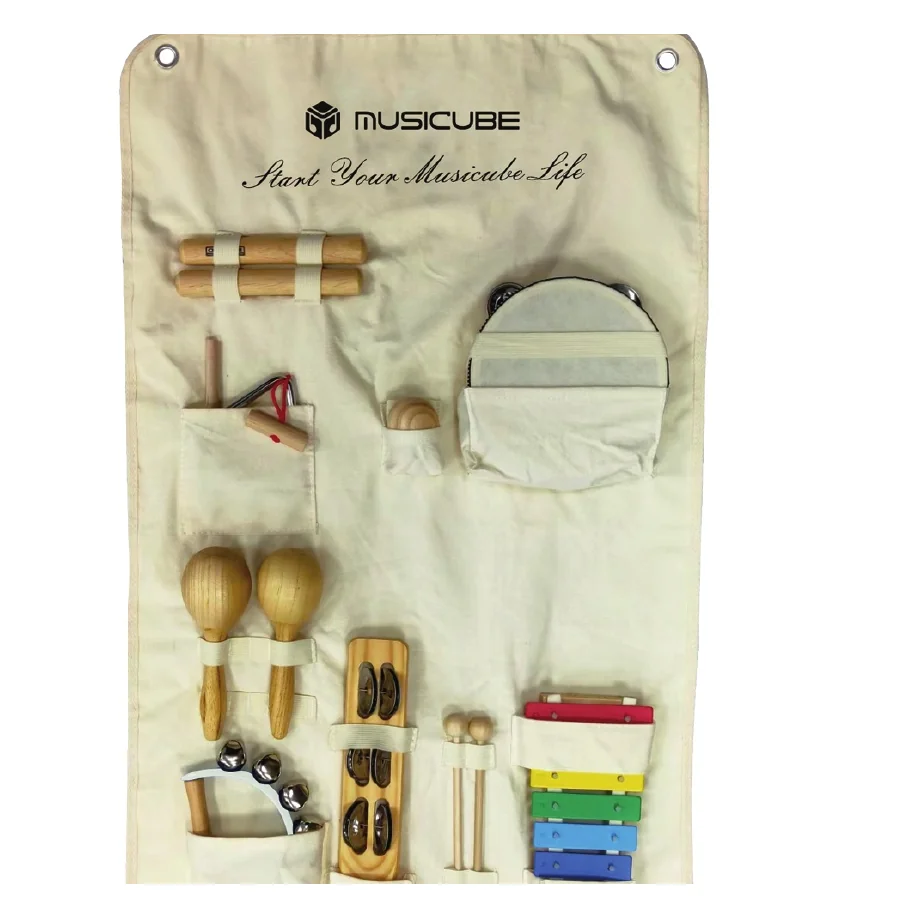
| 204063 | Wall hanging bag | 16 | 680 × 1,100 mm | 0.748 m² of wall | 0.047 m² |
The upright cart holds thirty-nine pieces on 0.125 m², about one fourteenth of the floor the flat eight-piece bag spends to hold a fifth as many: an upright container uses height and slots, a flat one uses area. The flat bag is not the worse product, only the wrong one for a full room. The wall bag is the third answer and the only one that trades floor for wall — 0.748 m² of clear wall, a real constraint where windows, pinboards and a whiteboard already have a claim.
Which arrangement suits a given percussion set is answered in choosing a classroom percussion set, which sets out the lidded box, the wall organiser and the trolley. What that page cannot do is give a footprint, because a footprint is a product fact rather than a buying principle.
Buy storage with the instruments
Storage bought a year after the instruments is a second shipment, with its own freight, minimum and lead time. On a container order that is an avoidable multiplication, best avoided at quotation stage.
The packing data makes the case better than argument. The 680 × 1,100 mm wall bag folds into a 465 × 365 × 240 mm carton; the 460 × 805 mm flat bag into a 255 × 240 × 95 mm box. Both travel inside an instrument order without changing how the container is built, which is the point: a line on a purchase order, not a second project.
What that line does to carton count, pallet and cubic metres belongs to how a wholesale Orff order is built. The terms behind it — per-model minimum, samples, lead time — are on what an Orff instrument manufacturer makes and on what terms. This page quotes none of them.
What the storage line has to specify
A line that says orff instrument storage gets a trolley. Six items turn it into something a factory can quote and a school can accept.
- The instrument list with box dimensions. Not model names: the item number and published box size for each, so shelf depth is derived rather than assumed.
- Clear height per tier, and the number of tiers. The tallest box plus the clearance you want above it — the only form that survives a change of model.
- Shelf depth in millimetres, at the deepest box. Stated as a minimum and marked as one, so a substitution cannot quietly shrink it.
- Linear run and the wall it goes on. Including what is already fixed there. A 7.3 metre run does not exist on a 4.5 metre wall; the plan has to say which gives.
- The add-on bar arrangement. Pocket per instrument or one divided tray, named in the order. This decides whether the set is still in F major in three years.
- Whether storage ships with the instruments. One shipment or two, stated on the order rather than found at the freight quote.
None of it is difficult. It is simply not on any catalogue page, which is why it gets decided by whoever builds the shelf.
How much floor space does an Orff instrument set need?
Can barred instruments be stored on top of each other?
What happens to the F-sharp and B-flat bars?
Explore Our Instruments
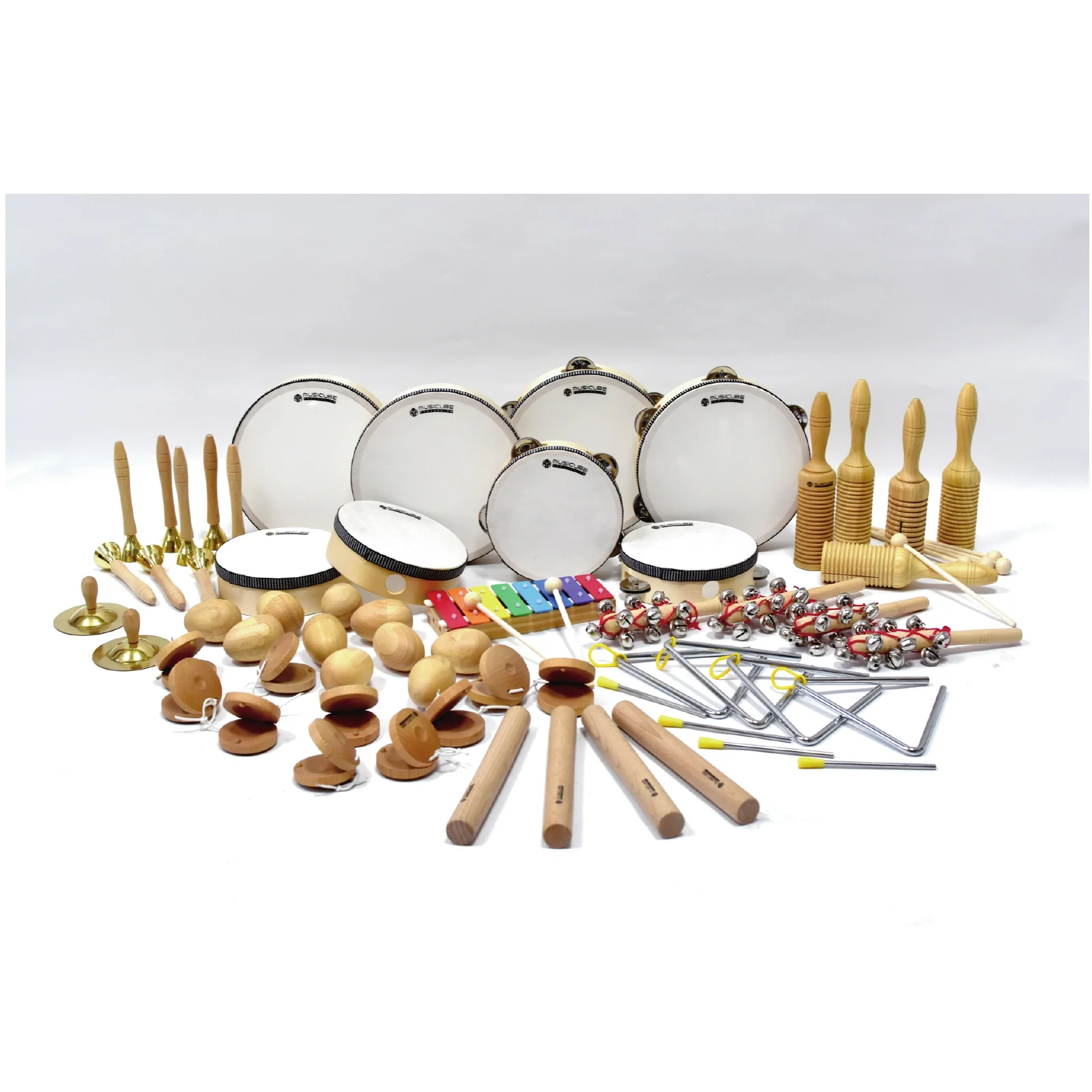 Percussion SetStorage cart · 204067
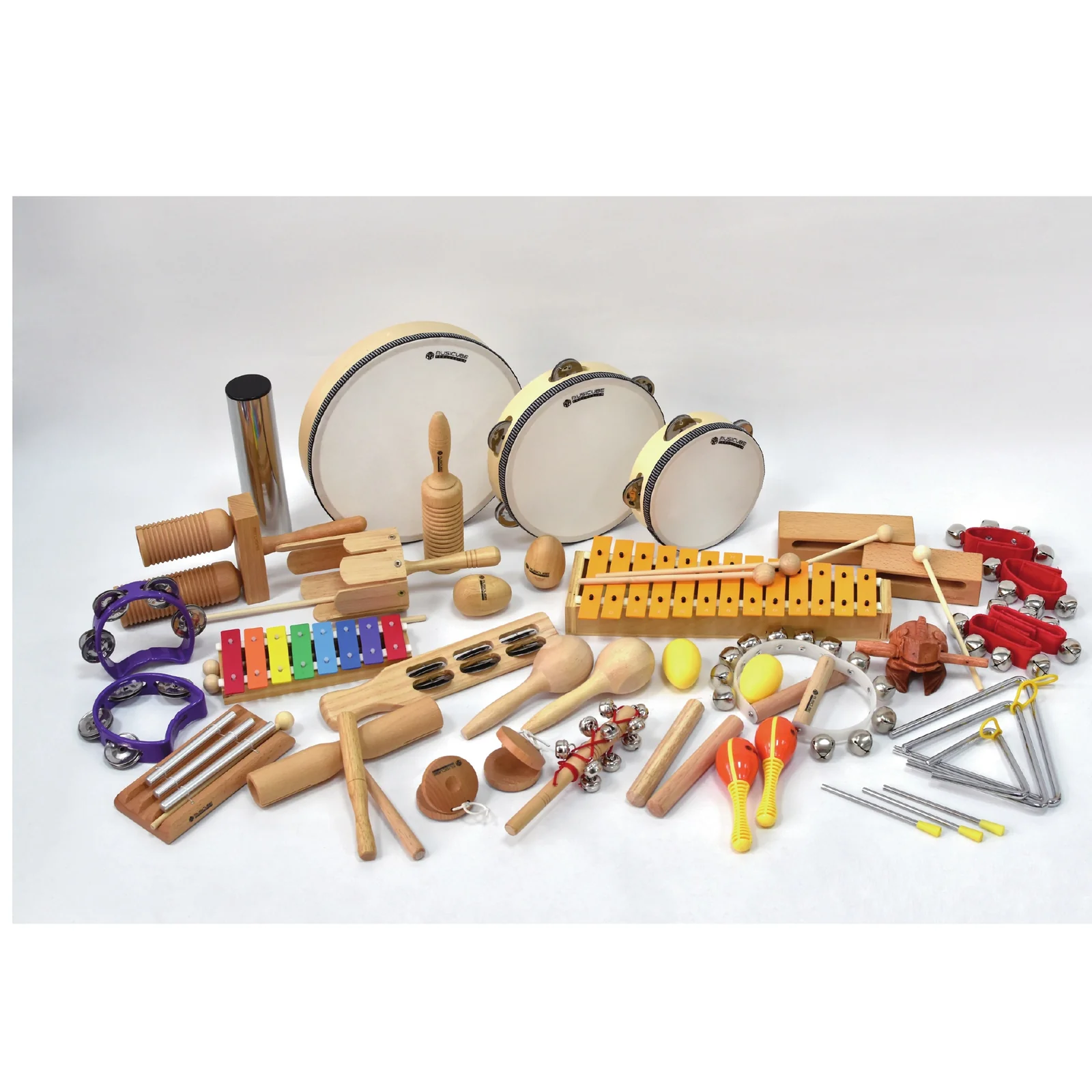 Percussion SetStorage tote · 204062
 Percussion SetWall hanging bag · 204063
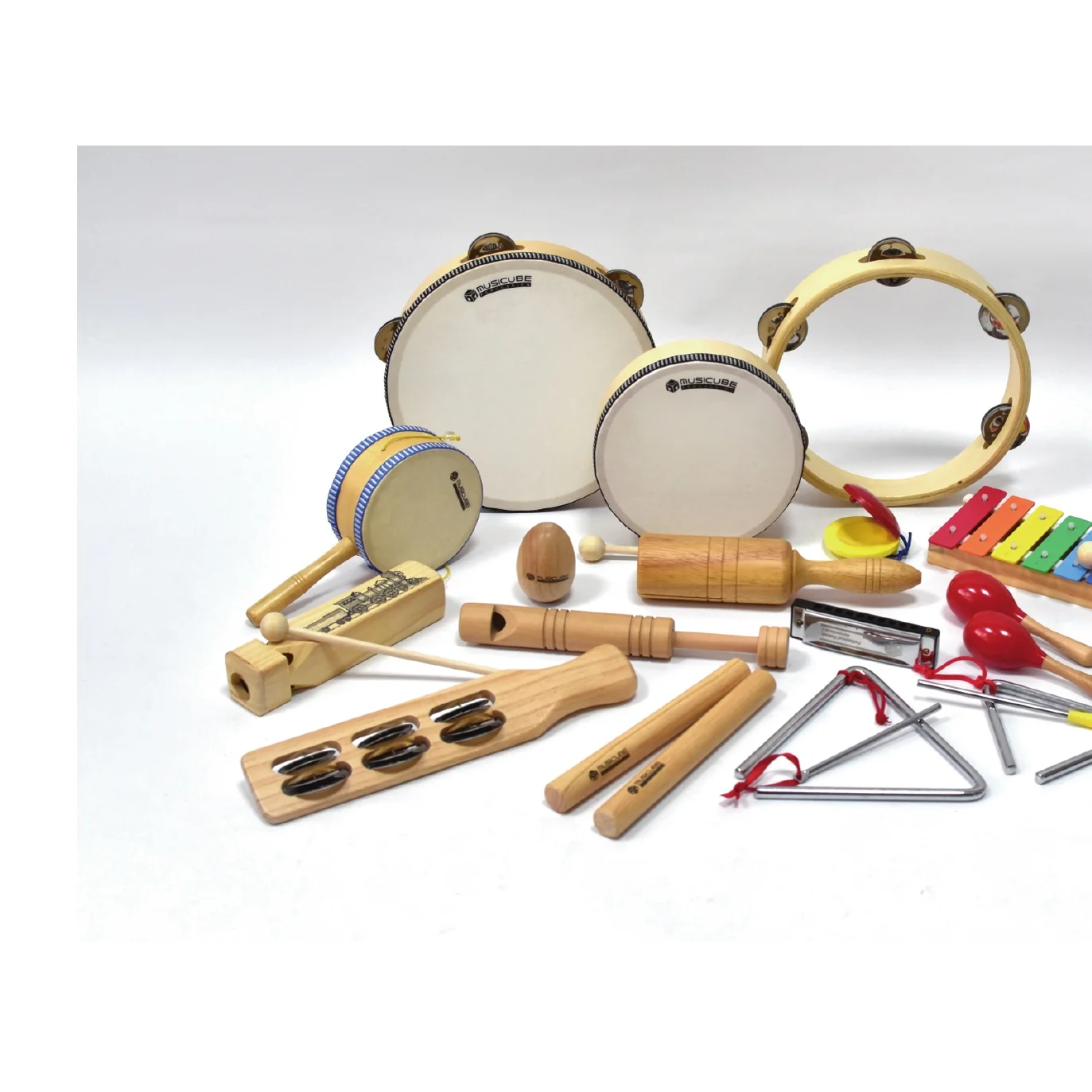
 Percussion SetStorage bag · 200213
Request a Quotation
Send the instrument list and the wall you have. We reply with the box dimensions per item, the shelf depth and clear height they need, and the storage formats that fit the same shipment.
1. West Music, Orff Stands & Carts and Orff Bags & Cases — read 2 November 2026 for how this market sorts storage into container types and brands, and the absence of any dimension against those categories.
2. Royalsound specifications for 051301, 051305, 051306, 051307, 052701, 200213, 204061, 204062, 204063 and 204067, read 2 November 2026. Every dimension, piece count and carton size here comes from those pages; derived figures are arithmetic on them — footprints are length times width, the shelf run is the sum of box lengths.