


By the Royalsound factory team — kids musical instrument manufacturer since 2003 · Updated October 2026
Looking for a children’s piano manufacturer means looking past the catalogue photos to the line that actually builds the instrument. This guide covers the kids piano range we run at our factory in Huai’an, Jiangsu: 18-key uprights, 25-key uprights and 30-key grand bodies, with the specifications, wholesale terms and documentation rules a buyer should hold before the first order goes on the water.
What the children’s piano range covers
A children’s piano is a mechanical keyboard instrument. Press a key and a tuned element strikes inside the body. No power supply, no speakers, no firmware, and nothing to retune when the weather turns. The note layout is chromatic, so what a child learns here carries over to a full-size keyboard, just across fewer octaves.
Three product families get sold under “kids piano,” and they are not the same thing:
| Family | Sound source | Note range on our line | Typical buyer |
|---|---|---|---|
| Children’s piano (this guide) | Tuned mechanical elements struck per key | 18 keys C4–F5; 25 keys C4–C6; 30 keys C3–F5 | Gift programs, nursery retail, display-led channels |
| Kids digital piano | Electronic tone engine with built-in speakers | 18 to 88 keys | Lesson programs, classroom use |
| Toy keyboard | Preset songs and beeps | Usually one octave, non-chromatic | Gift-shop price points |
The commercial difference matters. A children’s piano sells on silhouette and touch: cabriole legs, a hinged lid, a body that looks like a real instrument shrunk to child scale. A digital piano sells on function. If your channel is gift-led, the mechanical piano wins the shelf. If it is lesson-led, the electronic line does the work. Our kids digital piano guide covers that family in detail.
Grand and upright bodies across 18, 25 and 30 keys
Four mechanical bodies make up the range; the choice between an upright and a grand is a display decision as much as a musical one:
| Model | Keys and range | Body size (L × W × H) | Includes | SKUs on the line |
|---|---|---|---|---|
| 18 Keys Kids Piano | 18 keys, C4 to F5 | Approx. 325 × 255 × 295 mm | Keyboard stickers, illustrated songbook | 091807 purple; further colours across the line |
| 18 Keys Kids Grand Piano | 18 keys, C4 to F5 | Approx. 323 × 380 × 220 mm | Illustrated lid, stickers, songbook | 091810 sky blue; 091811 honey yellow |
| 25 Keys Kids Piano | 25 keys, C4 to C6, two full octaves | Approx. 420 × 255 × 295 mm | Keyboard stickers, illustrated songbook | 092502 white body with red lid |
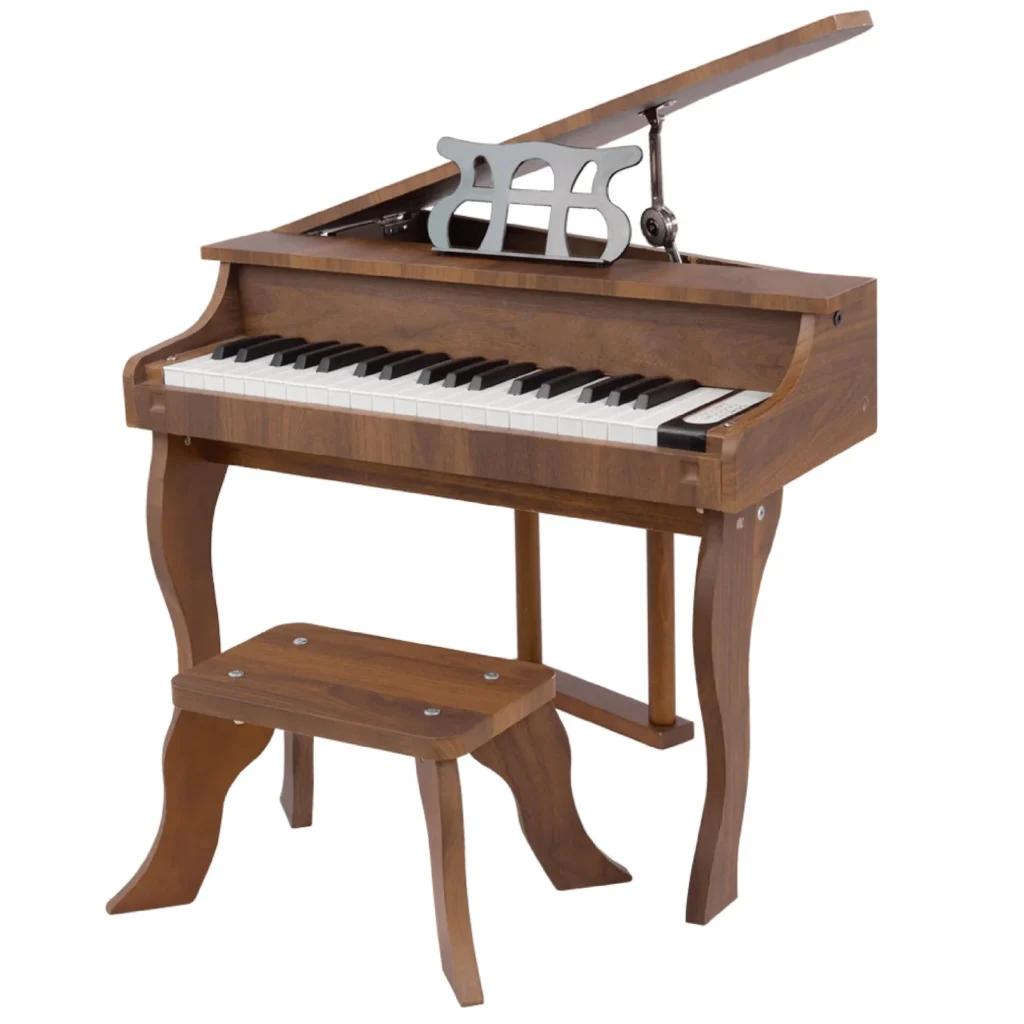
| 30 Keys Kids Grand Piano | 30 keys, C3 to F5 | Approx. 518 × 505 × 495 mm | Matching stool, cabriole legs, hinged lid, sheet-music rest, stickers, songbook | 093002 black; 093003 pearl white; 093741 walnut grain |
- The 18-key upright is the entry price point: compact body, low carton cost, and it fits a nursery shelf three-deep.
- The 25-key upright gives two full octaves, so a child plays real songs rather than a demo loop. It is the middle of the range and the safest first order.
- The 30-key grand is the display piece. Gift programs buy it because it photographs like a real instrument and anchors a window display.
- The 18-key grand splits the difference: the same 18-key range as the small upright in a grand silhouette with an illustrated lid.
Most programs start with the 25-key upright and add the grand for the premium end. Mixing bodies in one order is normal for retail programs; the packing scheme just gets agreed before bulk production starts.
Spec sheet: the 30-key grand (093741)
The 30-key grand 093741 is the reference body for OEM programmes, so this is the sheet we sign samples off against:
| SKU / Model | 093741 |
| Age range | 3+ years |
| Keys | 30 keys, chromatic scale from C3 to F5 |
| Tuning | Fundamental tuning |
| Material | FSC® certified MDF wood construction, CARB Phase 2 compliant |
| Finish | PU paint, walnut grain |
| Size | Approx. 518 × 505 × 495 mm (L × W × H) |
| Seating | Matching walnut-grain stool |
| Extras | Keyboard stickers and an illustrated songbook |
| Packaging | Brown box |
| Lead time | 25–45 days after deposit |
The black (093002) and pearl white (093003) grands carry the same specification; colour and stool finish are the only variables. Across the whole line the pattern repeats: FSC-certified MDF, PU paint surfaces, stickers and songbook in the box, and a brown export carton unless you specify retail packaging.
Five checks on the line that tunes the bodies
A trading company can photograph the same grand body. Five checks in the first exchange establish who owns the line that tunes it:
- The business licence. Ask for the licence showing manufacturing scope. A factory sends it; a trader sends a price list.
- The line. Ask which production line runs your model and who performs the final pitch check. A factory answers with a line and a name; a reseller changes the subject.
- The price ladder. A factory quotes unit price by quantity tier. A trader quotes one number and hopes you don’t ask for 500.
- The sample source. Samples should come off the production line, not a showroom hand-build. Ask where your sample will be built.
- The finish schedule. Ask which colourways actually ship this quarter. A factory knows its current schedule; a reseller forwards a catalogue from two seasons ago.
We are the manufacturer. The 20,000 m² factory in Huai’an, Jiangsu has built children’s instruments since 2003 and runs the full chain from material intake to export cartons. Running Musicube, our own consumer brand, in the US gives us a second read on how these bodies behave after a season on a real shelf — which finish scuffs, which lid hinge loosens, which songbook actually gets opened. Those are the notes the tuning and finishing teams work from. Browse the full kids piano range to see what currently ships.
Body materials and the tested finish
Every piano on this line is built from FSC-certified MDF, and the stock is CARB Phase 2 compliant. Surfaces are finished in PU paint, which is what gives the grands their grain and gloss. Three questions worth putting to any children’s piano manufacturer:
- Can you supply the FSC chain-of-custody certificate with the shipment paperwork? We can; the certificate travels with the documents.
- Is the MDF CARB Phase 2 compliant for US-bound orders?
- How are edges and corners finished on bodies children actually handle?
FSC certification covers responsible wood sourcing. It is not a toy-safety claim, and no honest factory will present it as one. Safety testing is a separate file, covered below.
Commercial terms on a grand and upright programme
A grand and upright OEM programme is quoted against these terms:
| MOQ | 200 pcs on standard models |
| Samples | 10–15 days for a pre-production sample |
| Bulk lead time | 25–45 days after deposit receipt |
| Shipping | FOB Qingdao / Shanghai / Ningbo; DDP quoted for EU and US destinations |
| Payment | T/T 30% deposit, 70% against B/L copy |
Ask for the unit price at two quantities — the trial run and the quantity you plan for the first full season. On an acoustic body the step between those numbers reflects board yield, finishing runs and tuning labour, which is exactly what a reseller cannot break out. Stickers and the illustrated songbook are packed with the instrument and the default shipper is a plain brown carton; retail boxes, freight, duties and destination paperwork sit on separate lines.
Carton count and container loading are calculated once the upright / grand split is fixed; market-specific documents are listed once the destination is named. Both are written into the order confirmation before production. Anyone offering a loading number before that split is known is estimating rather than planning.
A usable quotation for an OEM piano programme names MOQ, the tiered unit price, the lead time and the event it starts from, the Incoterm and port, and the payment schedule. If one is absent, the document is an indication rather than a quotation.
Quality gates on a piano line
Wood and mechanics fail differently than electronics. The gates that matter: incoming material verified against restricted-substance limits and certified sources; in-line checks at every production stage, covering tuning, edges, coatings and assembly; pull, drop and sound tests before a mass run is approved; and an AQL inspection with functional checks on finished goods, backed by full batch traceability. Every tuned instrument gets a pitch check before it is packed. A sour note or a loose key is a rebuild, not a discount.
Before the cartons close, ask for the AQL the line inspects to and for the inspection report itself. On a tuned instrument that report should cover pitch as well as appearance, and it should reach you while there is still time to rebuild. Our documented QC process is the sequence used for our own retail brand and for OEM orders.
Market-specific paperwork for acoustic bodies
The destination market decides which toy-safety tests and material declarations apply to an acoustic body; we state that list in writing before board is cut. The FSC® chain-of-custody certificate for the MDF ships with the paperwork as a sourcing record, not a safety certificate. Keep the written confirmation in the order file — a customs hold is the wrong moment to look for it.
Compliance logos circulate between supplier websites with no report behind them. Request the test report by number and issue date, and verify that it names the body you are ordering.
Private label: where your brand can go
OEM and ODM on this line is not a sticker exercise. What can carry your brand:
- The instrument itself, through imprint, laser engraving or in-mold branding.
- The accessories: keyboard stickers and the illustrated songbook.
- The packaging: brown export carton, full-colour retail box, gift box or storage case, with your barcode and warning panels.
- The finish: Pantone-matched colours to sit alongside your existing range.
- The instrument spec itself: key count, pitch range and scale tuned to your brief.
- The paperwork: manuals, songbook text and inserts printed in the languages your market requires.
ODM projects start from a market gap rather than a spec sheet. Bring a price point, an age group or a hole in your range, and our design office engineers the product, tunes it and hands you exclusivity on the design through contract. Sample cost is credited against the bulk order, and samples run 10–15 days on standard platforms. The full OEM/ODM service page covers what each track includes.
Opening an OEM piano programme
For an OEM programme the first message should carry the key count, the upright / grand split, the quantity of each, the destination and the branding route. Those five let us quote against a real bill of materials; anything less produces an estimate.
- Name the key count and the upright / grand split; that is enough to open an OEM quotation.
- Sign off a pre-production grand and a pre-production upright against the 093741 reference sheet.
- Confirm the imprint method, the retail box and the warning panels if the bodies carry your brand.
- Cutting the MDF starts at deposit, with the 25–45 day bulk window measured from sample approval.
Send the body split and quantities and we will return tiered pricing, MOQ and the sample-to-bulk timeline within 24 hours.
Questions OEM buyers put to us
Are you a children’s piano manufacturer or a trading company?
What MOQ applies to children’s piano orders?
How long do samples and bulk production take?
What is the difference between a children’s piano and a kids digital piano?
What is the piano body made of?
Can I sell the 30-key grand under my own brand?
What documentation ships with the order?
Can I mix models in one order?
Explore Our Instruments
 30 Keys Kids Grand Piano – Walnut Grain30 keys · C3–F5 · with stool · 093741
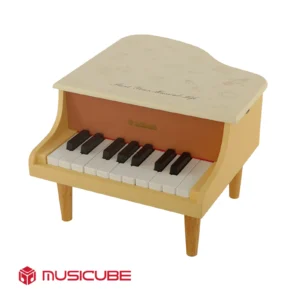 18 Keys Kids Grand Piano – Honey Yellow18 keys · C4–F5 · illustrated lid · 091811
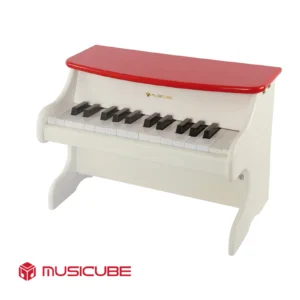 25 Keys Kids Piano – White/Red25 keys · C4–C6 · 092502
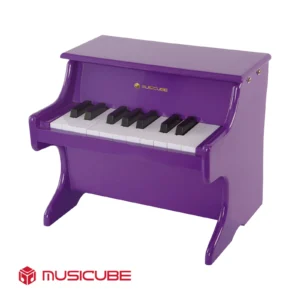 18 Keys Kids Piano – Purple18 keys · C4–F5 · 091807
Ready to Price Your Children’s Piano Order?
Include the finish and whether the programme needs a private-label box; the reply carries tiered pricing, MOQ and a sample schedule.
For the checks that sit outside the product specification, our 7-point factory audit checklist lists the reports, QC gates and commercial terms to request before a first order.