


By the Royalsound factory team — kids musical instrument manufacturer since 2003 · Updated October 2026
Searching for a kids piano factory is a different exercise from searching for a kids piano supplier. A supplier ships you a catalogue; a factory ships you instruments off a line it owns, and the difference shows up in the second order, not the first. This guide is about the line itself — what stations a piano passes through, where the 25–45 day bulk window actually goes, why the tuning bench sets the pace, and what to ask for before a deposit moves. We build the mechanical and digital kids piano ranges at our own 20,000 m² factory in Huai’an, Jiangsu, so this is written from inside the process.
What a piano production line actually includes
A piano is not a single operation. Every unit on our line passes through six stations, and each one is a place a buyer can ask a question:
| Station | What happens there | What to ask the factory |
|---|---|---|
| Material intake | MDF and timber stock received and verified against restricted-substance limits and certified sources | Which stock, certified how, and does the certificate travel with the shipment? |
| Machining and body forming | Bodies cut and formed — upright shells, grand shells, lids, legs and stools | Are bodies machined in-house or bought finished? |
| Finishing | PU paint applied and cured; colour matched to standard or Pantone references | Is each Pantone match a separate finish run, and when does the colour get locked? |
| Assembly | Action installed, keys bedded, lids and hardware fitted, stools matched to bodies | Who assembles, and is the action assembled on the same line as the bulk run? |
| Tuning | Every unit pitch-checked against the written spec before it leaves the bench | Who performs the final pitch check, and what happens to a unit that fails? |
| Inspection and packing | AQL inspection with functional checks, batch recorded, brown export carton or retail packaging applied | Is there batch traceability, and can a reorder be matched to a previous batch? |
A factory answers all six with a line and a name. A trader forwards the questions to someone else and comes back with a price. That difference is the whole point of the word.
How to verify the line before a deposit
Four checks separate a manufacturer from a reseller, and all four fit in one email. The same audit runs across our full ten-category range; on pianos specifically, ask these:
- The licence. Request the business licence showing manufacturing scope. A piano factory sends it; a trader sends a price list.
- Line ownership. Ask which stations run in-house. If bodies are bought finished and only the logo is applied, you are buying an assembled instrument, not a manufactured one.
- The sample source. Your sample must come off the production line, not a showroom hand-build — and its cost should be credited against the bulk order. Get that in writing.
- The price ladder. A factory quotes unit price by quantity tier: your trial quantity and your year-one quantity side by side. A trader quotes one number and hopes you do not ask for 500.
We are the manufacturer, and there is a second piece of evidence beyond paperwork: Musicube, our own retail brand, sells in the US market on the same QC system. A factory that has to live with its own retail returns audits itself harder than one that only quotes.
Where the 25-45 day window goes
The bulk window is not padding, and knowing what fills it tells you which orders slip. On a mixed piano program the clock runs roughly like this:
| Material prep | Stock pulled and verified against the approved sample reference |
| Machining and finishing | Bodies formed and painted; each Pantone match is its own finish run |
| Assembly | Actions bedded, keys fitted, hardware and stools matched — the longest single stage on a mixed order |
| Tuning and QC | Every unit pitch-checked and function-checked; batch recorded for traceability |
| Packing and loading | Cartons built to the agreed scheme; container loaded per the confirmed plan |
Two consequences a buyer should plan around. First, tuned instruments schedule ahead of accessories because the tuning bench is the bottleneck — on a mixed order, pianos and tongue drums set the pace, not the shakers. Second, the clock starts at deposit, not at enquiry. A brief that arrives complete gets a same-day quote; a brief missing the target market or the packaging preference gets a guess.
Why the tuning bench sets the pace
A plastic toy fails gracefully; a crack is a crack. A piano fails in ways a buyer can hear. Each key strikes a tuned element, and if the element or its seating moves in production, the note moves with it — that is a manufacturing problem, not a design problem, and it is caught at the bench, not at the port.
The gates on our line: every unit is pitch-checked against the written spec before it is packed; pull, drop and sound tests run before a mass run is approved; an AQL inspection with functional checks covers finished goods; and every batch is recorded so a reorder can be matched to what shipped before. A sour note is a rebuild, not a discount, and it never reaches the carton. The documented QC process on our quality page is the same one Musicube runs in US retail.
Spec sheet: the 30-key grand (093741)
This is the specification our wholesale buyers work from, taken from the product record:
| SKU / Model | 093741 |
| Age range | 3+ years |
| Keys | 30 keys, chromatic scale from C3 to F5 |
| Tuning | Fundamental tuning, pitch-checked per unit |
| Material | FSC® certified MDF construction, CARBcompliant™ Phase 2 |
| Finish | PU paint, walnut grain; matching walnut-grain stool included |
| Size | Approx. 518 × 505 × 495 mm (L × W × H) |
| Extras | Keyboard stickers and an illustrated songbook in the box |
| Packaging | Brown export box unless retail packaging is specified |
| Lead time | 25–45 days after deposit |
The mechanical line shares one material and tuning standard across every body: the 18-key upright (091807, 325 mm wide, C4–F5), the 18-key grands with illustrated lids (091810 sky blue, 091811 honey yellow), the 25-key upright (092502, two full octaves C4–C6) and the 30-key grands (093002 black, 093003 pearl white, 093741 walnut). Colour, key count and stool finish are the only variables — browse the full kids piano range to see what currently ships, which is why a mixed order is a packing problem, not an engineering one.
What moves the unit cost on a piano order
Four levers, none of them secrets, all of them belonging in the quote:
- Quantity tier. Price steps down as the order grows; ask for trial and year-one quantities side by side and read the gap.
- Colour count. Each Pantone match is a separate finish run. Standard finishes — purple, sky blue, honey yellow, white-and-red, black, pearl white, walnut grain — avoid it.
- Stool and accessory finish. The 30-key grands ship with a matching stool; a different stool finish is a second finish run, not a substitution.
- Print runs. Sticker sets and songbooks are printed per version, and every language is its own run. Lock the song list before bulk starts.
Check what the unit price includes: stickers and songbook ship in the box across the mechanical line, and packaging is the brown export carton unless you specify retail packaging. Freight, duties and market documentation sit outside the unit price.
Compliance files for the destination market
Where applicable, product testing and compliance documentation are reviewed according to the target market and agreed product requirements. Tell us where the pianos are going and we confirm in writing what applies to your order before production starts. The MDF on this line carries FSC® chain-of-custody certification and CARBcompliant™ Phase 2 stock, and the FSC certificate travels with the shipment paperwork. If your retail customer will ask for reports matched to the model, raise it before you sign the purchase order, not after the container sails — paperwork cannot be retrofitted onto a sailing vessel.
One warning about how this category is marketed: certification claims travel between supplier websites without paperwork behind them. Ask for the certificate or the test report, with a number and a date. If it cannot be produced, treat the claim as marketing copy.
Private label on the piano line
What can carry your brand: the instrument itself through imprint, laser engraving or in-mold branding; the accessories (stickers, songbook, manual); the packaging, from a sleeved brown box to a full-colour gift box quoted from volume; and Pantone-matched finishes on any body. ODM projects start from a market gap — bring a key count, a price point or a hole in your range, and our design office engineers and tunes it, with exclusivity through contract. Sample cost is credited against the bulk order. The full OEM/ODM service page covers what each track includes, and the toy piano guide walks the mechanical line model by model.
Mistakes that cost piano buyers time
These are the mistakes we see most often on first factory orders. None of them are about the instrument:
- Approving a sample without playing it. Play every key, check the tuning against a reference, compare the finish against the Pantone before you sign.
- Assuming the sample proves the bulk run. It proves the line can build it; the bulk run still needs the same line, the same bench and the recorded batch.
- Mixing key counts without a carton plan. Mixed models need the packing scheme agreed before bulk starts: which bodies share a carton, how retail boxes are labelled, how the loading is arranged. Repacking a sealed container is the expensive kind of mistake.
- Adding a Pantone colour after the quote. Each new colour is a finish run; late colour decisions are late production decisions.
- Leaving the target market until the end. It determines what documentation applies, and the answer needs to exist before the container sails.
How to start an order
Put five things in your first email and you will get a usable quote back the same day: key count or model, quantity, target market, packaging preference, and whether you need your own brand. Anything less and the quote is a guess.
- Send the model mix, quantities and target market. That is enough for a first quote.
- Approve a pre-production sample against the written spec.
- Confirm packaging and artwork if you are going private label.
- Bulk production starts at deposit and runs 25–45 days.
Request a quote with your quantities and we reply with pricing, MOQ and lead time within 24 hours.
Quick Answers
Are you a kids piano factory or a trading company?
How can I verify the factory before placing an order?
What is the MOQ at a kids piano factory?
How long do samples and bulk production take?
Which piano models can I order from the factory?
What are the payment and shipping terms?
Can I order the pianos under my own brand?
What documentation ships with the order?
Explore Our Instruments
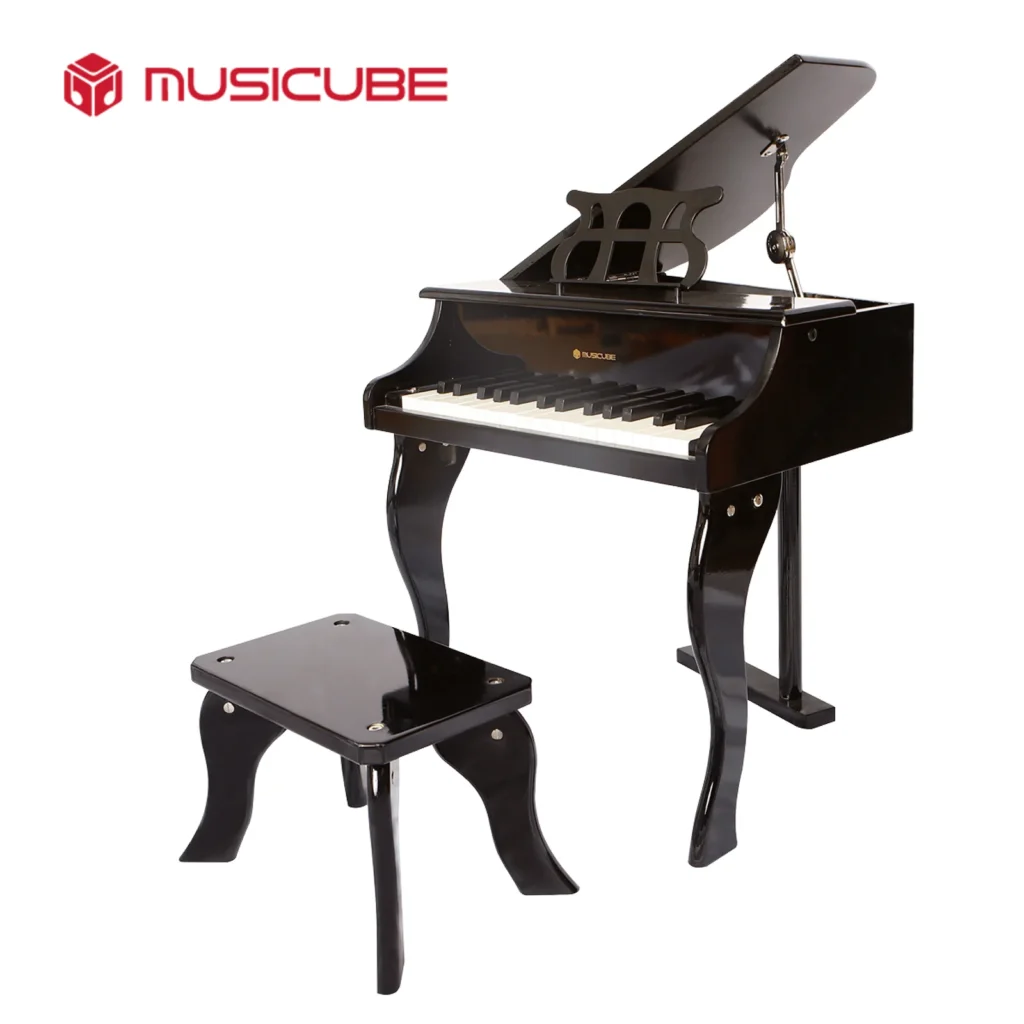
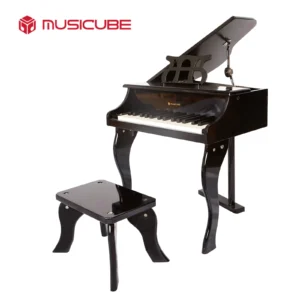 30 Keys Kids Grand Piano – Black30 keys · C3–F5 · with stool · 093002
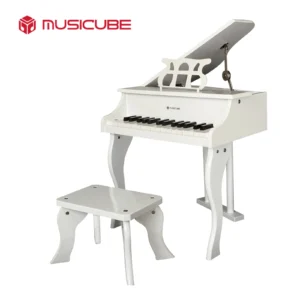 30 Keys Kids Grand Piano – Pearl White30 keys · C3–F5 · with stool · 093003
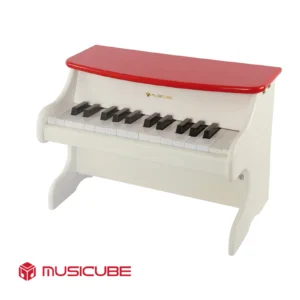 25 Keys Kids Piano – White/Red25 keys · C4–C6 · 092502
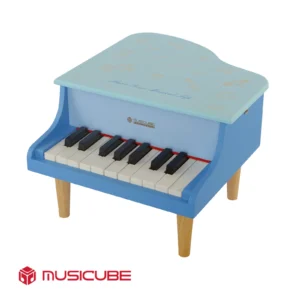 18 Keys Kids Grand Piano – Sky Blue18 keys · C4–F5 · illustrated lid · 091810
Ready to Price Your Piano Order?
Send your model mix, quantities and target market — we reply with pricing, MOQ and lead time within 24 hours.
If you are still shortlisting suppliers, our 7-point factory audit checklist sets out the test reports, QC gates and commercial terms worth requesting from every candidate before a first order.