

By the Royalsound factory team — kids musical instrument manufacturer since 2003 · Updated October 2026
A toy piano manufacturer is a harder thing to verify than a toy factory. The body is wood and paint; the product is a tuned musical instrument that happens to sit in the toy aisle. This guide covers the mechanical toy piano line we build at our factory in Huai’an, Jiangsu — 18-, 25- and 30-key chromatic pianos — with the specifications, wholesale terms and documentation rules a buyer should hold before the first order goes on the water.
What counts as a toy piano
A toy piano is a mechanical keyboard instrument. Press a key and a tuned element strikes inside the body. No batteries, no speakers, no firmware, and nothing to retune when the weather turns. The note layout is chromatic, so what a child learns on it carries over to a full-size keyboard, just across fewer octaves.
Three product families get sold under “toy piano,” and mixing them up is the most expensive mistake in this category:
| Family | Sound source | Note range on our line | Typical buyer |
|---|---|---|---|
| Toy piano (this guide) | Tuned mechanical elements struck per key | 18 keys C4–F5; 25 keys C4–C6; 30 keys C3–F5 | Gift programs, toy retail, nursery channels |
| Kids digital piano | Electronic tone engine with built-in speakers | 18 to 88 keys | Lesson programs, classroom use |
| Toy keyboard | Preset songs and beeps | Usually one octave, non-chromatic | Gift-shop price points |
The commercial difference matters. A toy piano sells on silhouette and touch: cabriole legs, a hinged lid, a body that looks like a real instrument shrunk to child scale. A toy keyboard sells on price and lights. If your channel is gift-led, the mechanical piano wins the shelf. If it is lesson-led, the electronic line does the work — our kids digital piano manufacturer guide covers that family.
The toy piano line: 18, 25 and 30 keys
Four bodies cover the line, and the key count decides who buys it:
| Model | Keys and range | Body size (L × W × H) | Includes | SKUs on the line |
|---|---|---|---|---|
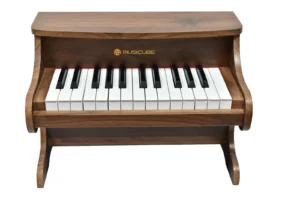
| 18 Keys Kids Piano | 18 keys, C4 to F5 | Approx. 325 × 255 × 295 mm | Keyboard stickers, illustrated songbook | 091807 purple |
| 18 Keys Kids Grand Piano | 18 keys, C4 to F5 | Approx. 323 × 380 × 220 mm | Illustrated lid, stickers, songbook | 091810 sky blue; 091811 honey yellow |
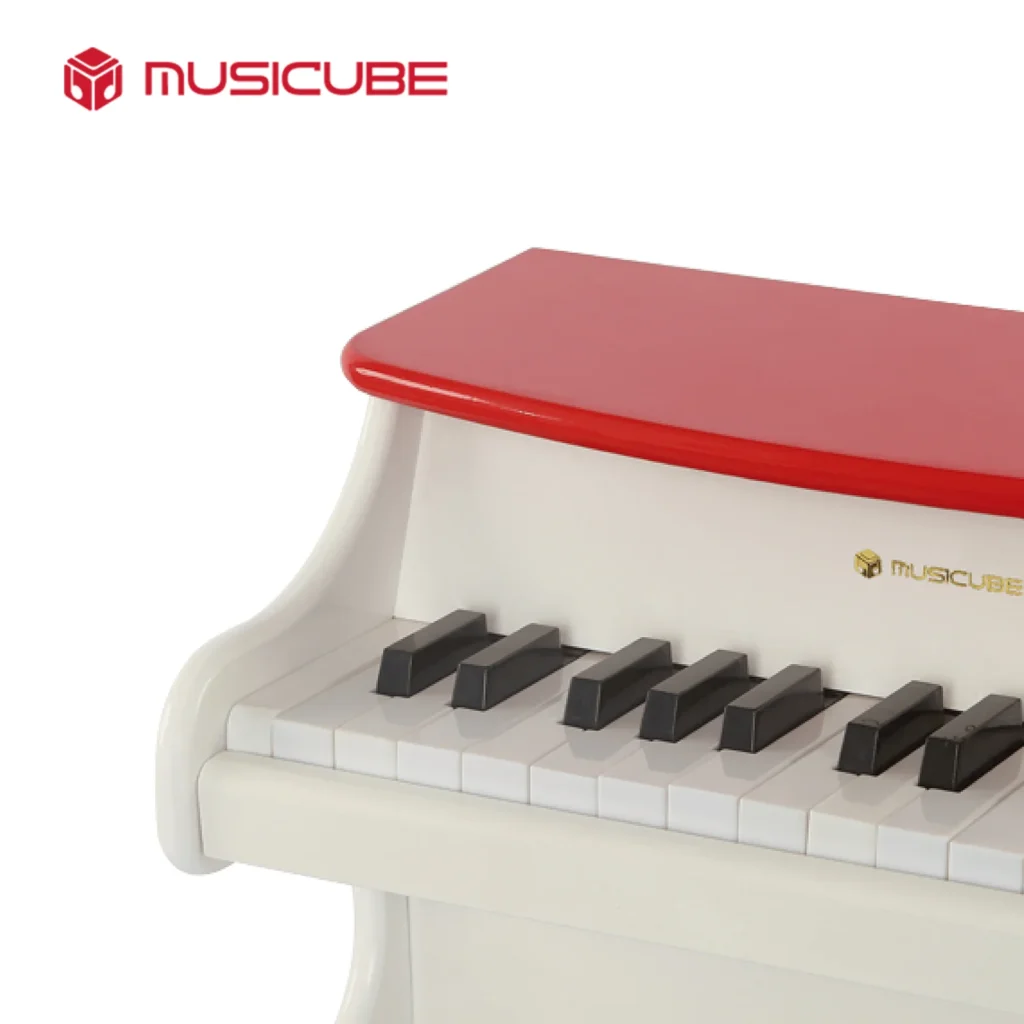
| 25 Keys Kids Piano | 25 keys, C4 to C6, two full octaves | Approx. 420 × 255 × 295 mm | Keyboard stickers, illustrated songbook | 092502 white body with red lid |
| 30 Keys Kids Grand Piano | 30 keys, C3 to F5 | Approx. 518 × 505 × 495 mm | Matching stool, cabriole legs, hinged lid, sheet-music rest, stickers, songbook | 093002 black; 093003 pearl white; 093741 walnut grain |
- The 18-key upright is the entry price point: compact body, low carton cost, and it fits a toy-aisle shelf three-deep.
- The 25-key upright gives two full octaves, so a child plays real songs rather than a demo loop. It is the middle of the range and the safest first order.
- The 30-key grand is the display piece. Gift programs buy it because it photographs like a real instrument and anchors a window display.
- The 18-key grand splits the difference: the same 18-key range as the small upright in a grand silhouette with an illustrated lid.
Most programs start with the 25-key upright and add the grand for the premium end. Mixing bodies in one order is normal; the packing scheme just gets agreed before bulk production starts.
Spec sheet: the 25-key toy piano (092502)
This is the specification our wholesale buyers work from, taken straight from the product record:
| SKU / Model | 092502 |
| Age range | 3+ years |
| Keys | 25 keys, chromatic scale from C4 to C6, two full octaves |
| Tuning | Fundamental tuning |
| Material | FSC® certified MDF wood construction, CARBcompliant™ Phase 2 |
| Finish | PU paint, white body with red lid |
| Size | Approx. 420 × 255 × 295 mm (L × W × H) |
| Extras | Keyboard stickers and an illustrated songbook |
| Packaging | Brown box |
| Lead time | 25–45 days after deposit |
The two-tone finish is the signature: a cream-white body under a red lid reads as a classic rather than a nursery colour, so it crosses the toy aisle and the gift shelf in one season. The black (093002), pearl white (093003) and walnut-grain (093741) 30-key grands carry the same material and tuning standard; colour and stool finish are the only variables. Across the whole line the pattern repeats: FSC-certified MDF, PU paint surfaces, stickers and songbook in the box, and a brown export carton unless you specify retail packaging.
Why toy piano manufacturing is not generic toy making
A plastic toy fails gracefully — a crack is a crack. A tuned instrument fails in ways a buyer can hear, and each failure mode is a manufacturing problem, not a design problem:
- Tuning drift. Each key strikes a tuned element; if the element or its seating moves in production, the note moves with it. Every instrument gets a pitch check before it is packed. A sour note is a rebuild, not a discount.
- Key action. A key that sticks or double-strikes traces back to the action assembly, and it shows up in the first week of retail, not on the factory floor.
- Wood movement. MDF is stable, but the finish has to survive freight and a humid container; PU paint over FSC-certified stock carries the grain and gloss to the shelf.
- Edges and corners. These bodies get handled by three-year-olds. Edge finishing is an in-line check, not an afterthought.
The gates on our line: incoming material verified against restricted-substance limits and certified sources; in-line checks at every production stage covering tuning, action, edges, coatings and assembly; pull, drop and sound tests before a mass run is approved; and an AQL inspection with functional checks on finished goods, backed by full batch traceability. The documented QC process on our quality page is the same one we run for our own retail brand, Musicube, which sells in the US market, so retail feedback goes straight back into production.
How to verify a toy piano manufacturer
Every supplier claims factory-direct pricing. The difference between a manufacturer and a reseller shows up in five places, and all five fit in one email:
- The licence. Ask for the business licence showing manufacturing scope. A factory sends it; a trader sends a price list.
- The line. Ask which production line runs your model and who performs the final pitch check. A factory answers with a line and a name; a reseller changes the subject.
- The price ladder. A factory quotes unit price by quantity tier. A trader quotes one number and hopes you don’t ask for 500.
- The sample source. Samples should come off the production line, not a showroom hand-build. Ask where your sample will be built.
- The finish schedule. Ask which colourways actually ship this quarter. A factory knows its current run; a reseller forwards a catalogue from two seasons ago.
We are the manufacturer. The 20,000 m² factory in Huai’an, Jiangsu has built children’s instruments since 2003 and runs the full chain from material intake to export cartons. Browse the full kids piano range to see what currently ships.
Wholesale terms that belong on your quote
These are the terms we publish, and they are the terms to demand from any supplier:
| MOQ | 200 pcs on standard models |
| Samples | 7-15 days for a pre-production sample |
| Bulk lead time | 25–45 days after deposit receipt |
| Shipping | FOB Qingdao / Shanghai / Ningbo; DDP quoted for EU and US destinations |
| Payment | T/T 30% deposit, 70% against B/L copy |
A unit price means nothing without the tier next to it. Ask for pricing at your trial quantity and at the quantity you expect to reach in year one; the gap tells you how the factory prices growth. Confirm what the unit price includes: on this line the stickers and songbook ship in the box, and packaging is the brown export carton unless you specify retail packaging. Freight, duties and market documentation sit outside the unit price.
Two things stay off the first quote on purpose: carton quantity and container loading, which depend on your model mix, and market-specific paperwork, which depends on your destination. Both get confirmed in writing before production starts.
Materials: what the body is made of
Every piano on this line is built from FSC-certified MDF with CARBcompliant™ Phase 2 stock, finished in PU paint — the finish is what gives the grands their grain and gloss. Three questions worth putting to any toy piano manufacturer:
- Can you supply the FSC chain-of-custody certificate with the shipment paperwork? We can; the certificate travels with the documents.
- Is the MDF CARB Phase 2 compliant for US-bound orders?
- How are edges and corners finished on bodies children actually handle?
FSC certification covers responsible wood sourcing. It is a material claim, not a toy-safety certificate, and no honest factory presents it as one. Safety testing is a separate file, covered below.
Documentation: state your market first
Where applicable, product testing and compliance documentation are reviewed according to the target market and agreed product requirements. Tell us where the pianos are going and we confirm in writing what applies to your order before production starts. The FSC certificate for the MDF ships with the paperwork. Get that confirmation in writing; a verbal assurance does not survive a customs delay.
One warning about how this category is marketed: certification claims travel between supplier websites without paperwork behind them. Ask for the certificate or the test report, with a number and a date. If it cannot be produced, treat the claim as marketing copy.
Private label on the toy piano line
OEM and ODM here is not a sticker exercise. What can carry your brand:
- The instrument itself, through imprint, laser engraving or in-mold branding.
- The accessories: keyboard stickers and the illustrated songbook.
- The packaging: brown export carton, full-colour retail box or gift box, with your barcode and warning panels.
- The finish: Pantone-matched colours to sit alongside your existing range.
- The spec and the paperwork: key count, pitch range, manuals and songbook text tuned to your brief and printed in the languages your market requires.
ODM projects start from a market gap rather than a spec sheet: bring a price point, an age group or a hole in your range, and our design office engineers the product, tunes it and hands you exclusivity on the design through contract. Sample cost is credited against the bulk order. The full OEM/ODM service page covers what each track includes.
How to start an order
Put five things in your first email and you will get a usable quote back the same day: key count, quantity, target market, packaging preference, and whether you need your own brand. Anything less and the quote is a guess.
- Send the key count, body style, finish and target market. That is enough for a first quote.
- Approve a pre-production sample against the written spec.
- Confirm packaging and artwork if you are going private label.
- Bulk production starts at deposit and runs 25–45 days.
Request a quote with your quantities and we reply with pricing, MOQ and lead time within 24 hours.
Quick Answers
Are you a toy piano manufacturer or a trading company?
What is the difference between a toy piano and a toy keyboard?
What MOQ applies to toy piano orders?
How long do samples and bulk production take?
Which toy piano models can I order?
What is the piano body made of?
What documentation ships with the order?
Can I sell the toy pianos under my own brand?
Explore Our Instruments
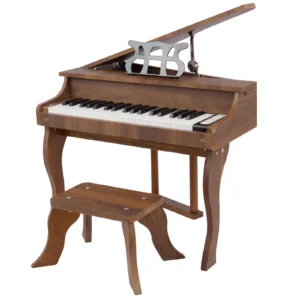 30 Keys Kids Grand Piano – Walnut Grain30 keys · C3–F5 · with stool · 093741
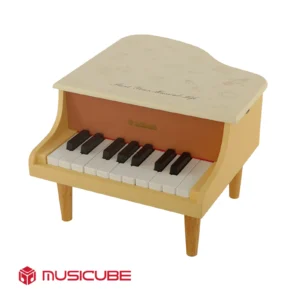 18 Keys Kids Grand Piano – Honey Yellow18 keys · C4–F5 · illustrated lid · 091811
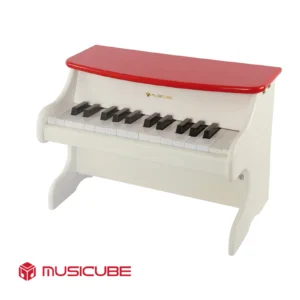 25 Keys Kids Piano – White/Red25 keys · C4–C6 · 092502
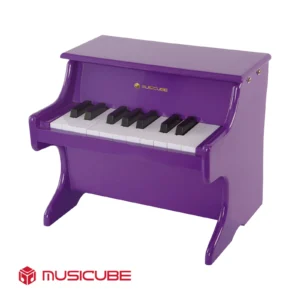 18 Keys Kids Piano – Purple18 keys · C4–F5 · 091807
Ready to Price Your Toy Piano Order?
Send your key counts, quantities and target market — we reply with pricing, MOQ and lead time within 24 hours.